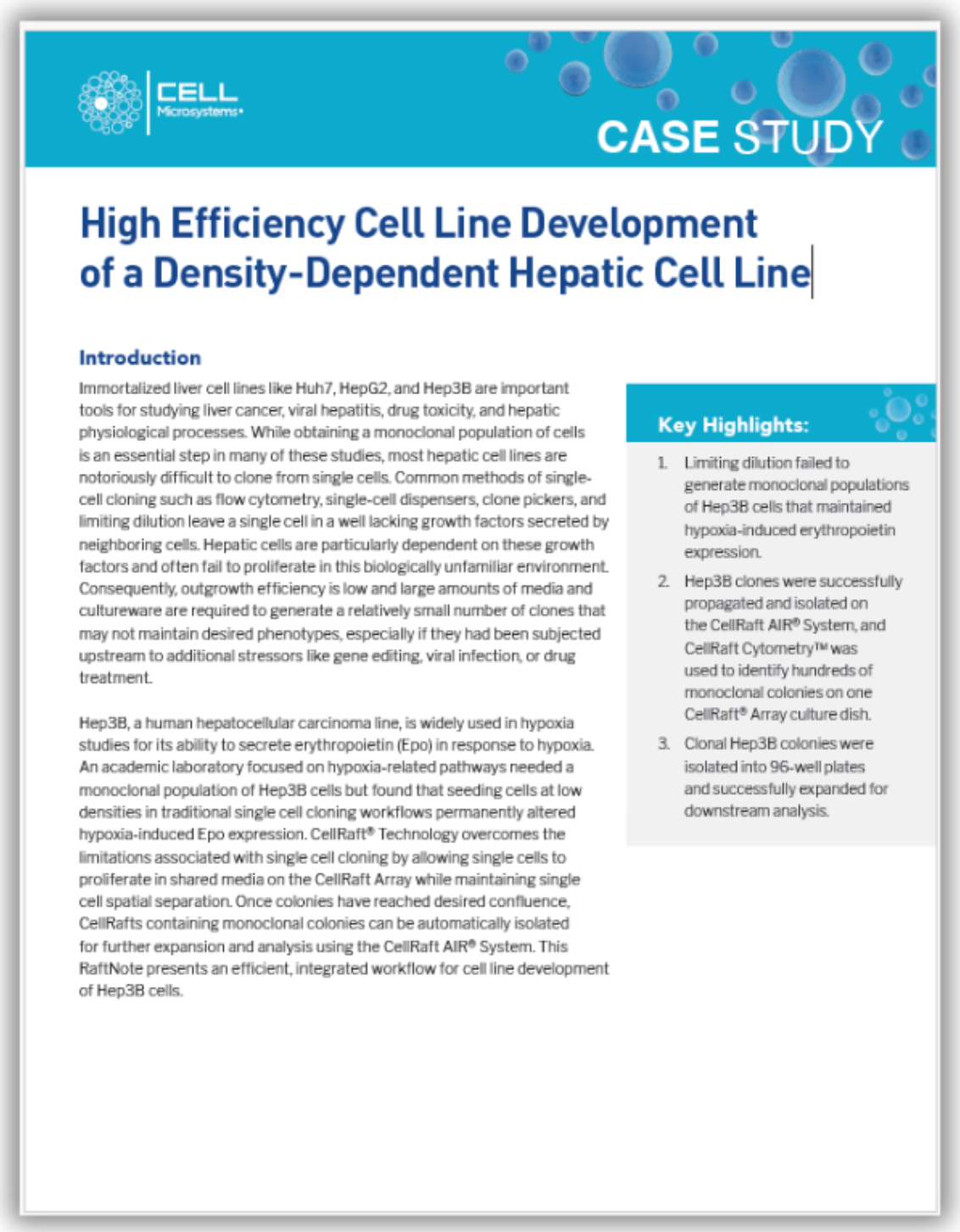

If you work with difficult-to-clone cell types, you will appreciate the challenge researchers at this lab faced in generating monoclonal populations of Hep3B human hepatoma cells. When they plated their cells using limiting dilutionA statistical cloning approach where cells are diluted to low density to “hopefully” seed one cell per well; commonly used but can be low-efficiency for difficult-to-clone lines. More, populations that originated from a small number of cells (1-3 cells) exhibited a permanently altered hypoxia response.
To address this issue, researchers turned to Cell Microsystems’ Clone Challenge to leverage our CellRaftA microscale polystyrene growth surface within an array used to spatially segregate cells/colonies while maintaining shared media access, enabling imaging over time and targeted isolation. More Technology. In this case study, see how our technology was used to successfully generate hundreds of colonies that retained the desired phenotype while using significantly less media, cultureware, and hands-on time compared to limiting dilutionA statistical cloning approach where cells are diluted to low density to “hopefully” seed one cell per well; commonly used but can be low-efficiency for difficult-to-clone lines. More.