
Tired of being limited by limiting dilution?
Traditionally, a limiting dilutionA statistical cloning approach where cells are diluted to low density to “hopefully” seed one cell per well; commonly used but can be low-efficiency for difficult-to-clone lines. More method is used to isolate and generate single cell-derived clones, however, it is both time and cost prohibitive due to low efficiency of success and the manual labor input required.
CellRaft® Technology offers an affordable, automated solution to an otherwise labor-intensive workflow while:
- maintaining cell health
- providing time-course imaging for clonal verification
- delivering automated isolation of cells, colonies, or organoids

Grow More Colonies
Single cells are grown in a flask-like environment, without physically separating them, eliminating perturbation to cell physiology and ensuring the viability and vitality of single cells as they develop into clones. The CellRaftA microscale polystyrene growth surface within an array used to spatially segregate cells/colonies while maintaining shared media access, enabling imaging over time and targeted isolation. More AIR® system is able to scan more than 60,000 individual cells per CellRaft ArrayConsumables containing thousands of microwells (containing CellRafts) for spatial segregation, imaging, and isolation of single cells, monoclonal colonies, or 3D cultures. More, which is 500X more cells than a traditional 96-well plate with limiting dilutionA statistical cloning approach where cells are diluted to low density to “hopefully” seed one cell per well; commonly used but can be low-efficiency for difficult-to-clone lines. More.
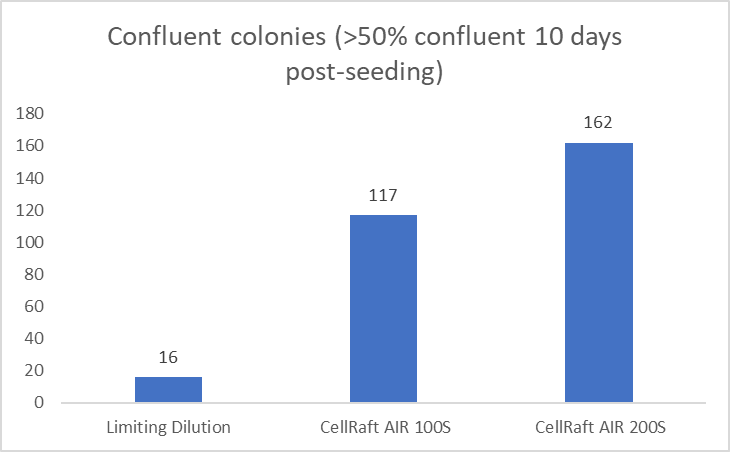
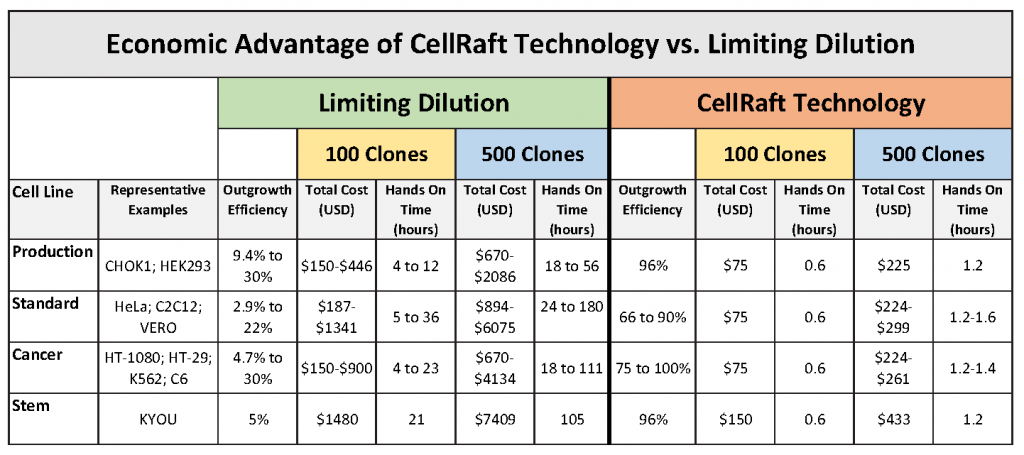
Experimental and cost analyses including hands-on time to run the protocol between limiting dilutionA statistical cloning approach where cells are diluted to low density to “hopefully” seed one cell per well; commonly used but can be low-efficiency for difficult-to-clone lines. More and CellRaftA microscale polystyrene growth surface within an array used to spatially segregate cells/colonies while maintaining shared media access, enabling imaging over time and targeted isolation. More Technology indicate that the latter delivers a high return on investment in terms of outgrowth efficiency, time, and cost.
Save Time and Money – Reduce the Cost per Clone
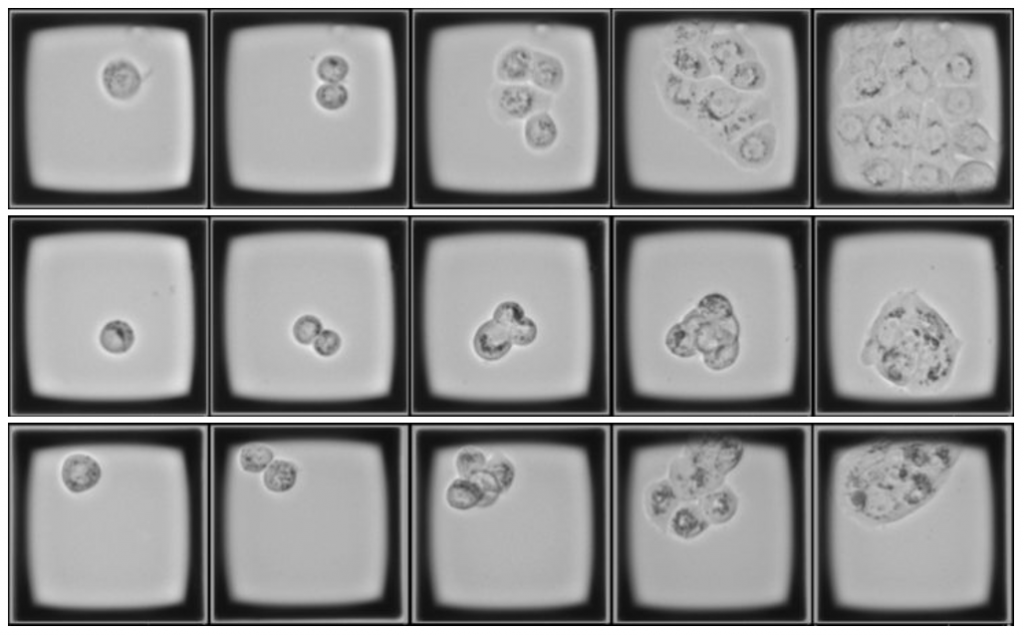
Finally! Image-based Proof of Monoclonality
Time-course imaging is a key feature of the CellRaft AIR SystemAn all-in-one platform for imaging, identifying, and isolating viable single cells, colonies, or organoids using CellRaft Arrays and software-guided selection with CellRaft Cytometry. More. After cells are seeded on the CellRaft ArrayConsumables containing thousands of microwells (containing CellRafts) for spatial segregation, imaging, and isolation of single cells, monoclonal colonies, or 3D cultures. More, the array is serially scanned at the desired frequency to capture complete growth records of clonal development.
Challenges with Limiting Dilution:
- Lack of viable clones
- Lack of proof of monoclonalityEvidence that a colony/line originated from one cell; often supported by time-course imaging and traceability. More
- Requires significant lab supplies and equipment
- Hands-on time requirements
- Limited throughput