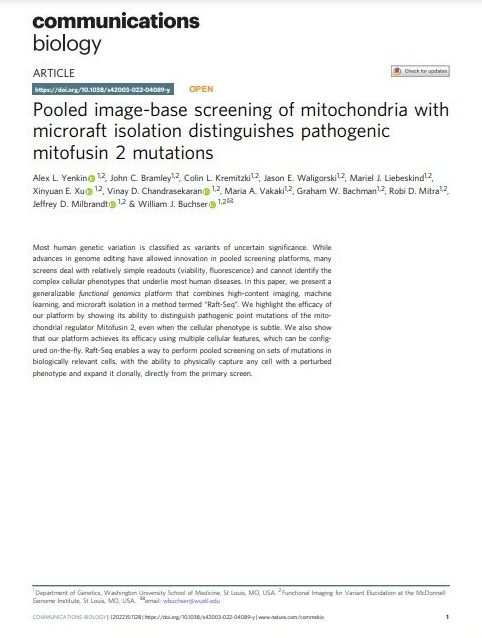
A major limitation with pooled screening platforms is the inability to identify phenotypic characteristics associated with cells of interest. Most platforms generate simple readouts such as viability and fluorescence. Using a method termed “Raft-Seq” this paper demonstrates how the CellRaft AIR System was able to distinguish pathogenic point mutations of the mitochondrial regulator Mitofusion 2. The CellRaft AIR System was used to generate clones for monitoring phenotypes as well as isolating cells of interest for downstream sequencing. The CellRaft Technology was compared against 4 other cell screening-imaging platforms (Arrayed screening, In situ sequencing, photo-activation, and CRaft-ID) and among 7 comparison criteria (Imaging constraints, how cells are collected, genotype resolution, live cell collection, genotyping method, pooled scalability, and bottleneck). Overall, the platforms and comparison criteria, the CellRaft Technology dominated the competition by making it possible to examine phenotypic characteristics of live cells on a single cell genotype resolution with an ability to isolate out cells of interest for further downstream NGS.