
Blog

Mitigate contamination issues of shear flow experiments

See how Dr. Belleannée addressed contamination concerns in her laboratory

The BioFlux system is a game-changer in the world of experimental research. By employing a multiplexed array format, it revolutionizes the way flow cell experiments are conducted. Just picture this: a single 48-well plate has the potential to run an impressive 24 assays concurrently. And with the introduction of the Quattro add-on, a staggering 96 experiments can run in parallel. This substantial boost in data throughput means researchers can delve into more conditions, test hypotheses, and uncover drug pharmacology faster than ever before. But as we’ll learn in this case study, the real-world benefits go far beyond multiplexing.



Clemence 2

Increasing both data throughput and integrity

Dr. Clemence Belleannée and her team at the University of Laval take advantage of BioFlux system’s contactless pumping to improve experimental throughput and data integrity

While the BioFlux system’s capacity for multiplexing experiments is widely celebrated, there’s an equally vital but less-discussed feature that significantly elevates both throughput and data integrity: “contactless” pumping. In this case study, we’ll delve into the concept behind contactless pumping, its crucial features, and its transformative impact in the laboratory of Dr. Clemence Belleannée at the Universite Laval in Quebec City, Canada who has been using BioFlux since 2015.

Overview 

The unique technology of the BioFlux system has left an indelible mark on Dr. Belleannée’s research team at the University of Laval. Their work focuses on developing a reversible male contraceptive that preserves male fertility and additionally, explores novel therapeutic approaches to prostate cancer. 

Challenges 

The team sought a system that could investigate the function and response of shear stress without requiring fluid exchange, to reduce the likelihood of contamination. 

Outcomes 

Fluxion’s BioFlux system, with its gas-driven flow cell setup, met the team’s needs without necessitating fluid exchange. This has empowered their research in numerous ways. 

Key Benefits (according to Dr. Belleannée) 

  • Contamination Mitigation: The absence of liquid exchange in the system reduces the risk of contamination in samples and assays while maintaining a low-effort setup. 
  • Tailored for Specific Research: The BioFlux system aligns perfectly with the unique requirements of their specific research field, delivering controlled shear to meet their needs.
  • Exceptional Customer Support: Investing in the BioFlux system came with outstanding vendor support, an invaluable asset to the team’s work over the years. 

Ditching the Drawbacks of Traditional Microfluidic Flow Cells 

In traditional flow cell systems, even the microfluidic ones, fluid flow is typically managed by syringe pumps, peristaltic pumps, or similar direct-fluid-contact approaches. However, the BioFlux system takes things a step further with its pneumatic pressure-driven pumping mechanism.

The limitations of traditional liquid pumps in conjunction with microfluidic flow cells are glaring: 

  • To reduce the likelihood of contamination, the entire fluidic network necessitates thorough cleaning or replacement after every experiment, increasing both hands-on time and cost. 
  • Connections and tubing that link the pump to the flow cell, introduce dead volume throughout the system and increase the sample, media, and treatment requirements. 
  • Low flow rates essential for microfluidic flow cells lead to substantial flow rate variations, diminishing accuracy.
     
  • The level of multiplexing achievable is capped due to the complex tubing manifolding, which introduces flow resistance discrepancies, further amplifying variability. 


BioFlux Pneumatic Pumping: The Key to Precision, Multiplexing, and Speed 

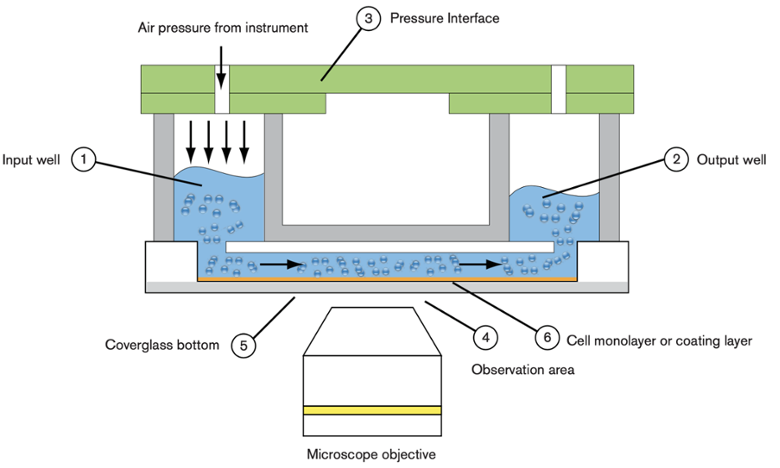
To address these issues, Fluxion introduced the innovative use of pneumatic pressure-driven flow within the BioFlux system. The system integrates an array of microfluidic flow cells into the base of a standard size plate, solving the “macro to micro interface” challenge inherent to many microfluidic devices. In its simplest form, a microfluidic flow cell comprises an inlet well and an outlet well connected by the microfluidic flow cell channel. 
 

BioFlux Plate Design 1

Pneumatic pumping-precision without liquid contact

Pneumatic tubing connects to the interface to deliver gas pressure to the microfluidic well plate. The controller delivers precise gas pressure based on the user-determined flow profile for the experiment. 
BioFlux CFD

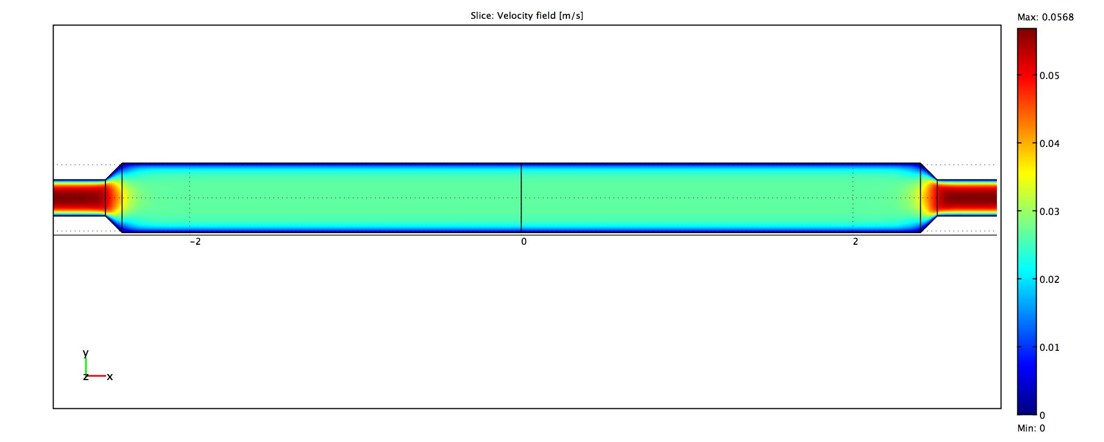
Computational fluid dynamics is used to model flow in the microfluidic channels. The flow profiles are then validated experimentally. This image of the CFD-analyzed flow demonstrates the uniformity of the wall shear stress profile across the BioFlux 48-well low shear stress plate. The channel diameter is 350um- 5 human hairs.


The Unparalleled Benefits of BioFlux’s Pneumatic Pressure-Driven Pumping 

  • Rapid Setup: Loading samples into the wells and attaching the interface is all that’s needed. There are no pumps, tubing, or connectors in the flow path – pneumatic pressure-driven flow takes care of the rest.
  • Clean & Fast Experiment Turnaround: There’s no need for the time-consuming cleaning or replacement of syringes, tubing, or connections between experiments to prevent contamination. 
  • Flow Accuracy: Pneumatic pumping seamlessly scales to the extremely low flow rates necessary for microfluidic assays, ensuring precision. 
  • Throughput: Pressure-driven flow easily multiplexes, with BioFlux’s ability to run up to 96 experiments simultaneously from a single controller. 

Learn more about the BioFlux System and the difference it can make in your lab.

BioFlux Applications

BioFlux Videos

BioFlux System

Anson Blanks

Dr. Anson Blanks completed his BS in exercise physiology at East Carolina University and his MS in clinical exercise science at Appalachian State University. After working as a clinical exercise physiologist in cardiopulmonary rehabilitation, Dr. Blanks decided to pursue a career in scientific research. He attended Virginia Commonwealth University, where he completed his Ph.D. in Rehabilitation and Movement Science. After spending several years as a research and development scientist in biotechnology industry, Dr. Blanks is now a scientific marketing manager for Cell Microsystems in Durham, NC.


Related Posts

Unlocking the Secrets of Antibiotic Resistance: How Shear Flow Systems Are Revolutionizing the Fight Against Superbugs

In the ongoing battle against antibiotic-resistant bacteria, or “superbugs,” scientists are constantly seeking innovative tools to understand the mechanisms of resistance and develop effective treatments. One such groundbreaking technology is shear flow systems, which have emerged as game-changers in microbiological research. By simulating the dynamic conditions of bacteria’s natural environments, such as the human body or food processing, shear flow systems provide unique insights into bacterial behavior and resistance mechanisms that traditional static methods simply cannot achieve. In this blog post, we’ll explore the benefits of using shear flow systems to combat antibiotic resistance and develop next-generation therapies.

Why Shear Flow Systems Are Essential for Studying Antibiotic Resistance

Antibiotic resistance is a complex phenomenon influenced by a variety of factors, including genetic mutations, horizontal gene transfer, and the formation of biofilms. Traditional laboratory methods often fail to capture the dynamic nature of these processes, leading to incomplete or misleading results. Shear flow systems address this limitation by providing a more realistic environment for bacterial growth and interaction. Here’s how:

1. Mimicking Real-World Conditions

In the human body, bacteria are rarely in a static state. They are constantly exposed to fluid flow, such as blood circulation or urine flow, which influences their behavior and resistance mechanisms. Shear flow systems can replicate these conditions, allowing researchers to study how bacteria respond to antibiotics under realistic physiological conditions. This is critical for understanding how resistance develops and persists in vivo. This benefit was recently highlighted in a webinar presented by Dr. Katharina Richter, a microbiology researcher from the University of Adelaide in Australia. Using a high-throughput BioFlux Shear Flow System, Dr. Richter and her team were able to test 3 different methods of superbug treatments under physiological conditions.

2. Studying Biofilm Formation and Resistance

Biofilms—structured communities of bacteria encased in a protective matrix—are a major contributor to antibiotic resistance. Biofilms are notoriously difficult to treat because they shield bacteria from antibiotics and the immune system. Shear flow systems enable researchers to study biofilm formation in real time, observing how bacteria adhere to surfaces, form microcolonies, and develop resistance under flow conditions. For example, using a BioFlux, Dr. Richter was able to leverage high-resolution imaging to obtain unprecedented insight into the biofilm killing and prevention efficacy of a copper and diethyldithiocarbamate (DDC) combination nanoparticles¹. The group is currently investigating the use of a Cu-DDC infused gel that can be injected into wounds that are at high risk for chronic infection, such as hernia.

From Milliliters to Microliters: How a Shear Flow System Can Reduce Sample Requirements for Experiments

Imagine working with a rare patient-derived cell samples. In a traditional setup, you might need 1 milliliter of sample (equivalent to about 20 drops) to run an experiment. With a microfluidic system, you could potentially get the same results with just 10 microliters (about one-half of a single drop). This efficiency opens up entirely new research possibilities, especially in fields where sample availability is a limiting factor.

Whether due to rarity, cost, or difficulty in obtaining samples, the ability to conduct meaningful experiments with limited sample volumes has long been a goal in biological and chemical research. In this quest for more efficient and precise laboratory techniques, microfluidic shear flow systems have emerged as game-changing tools. These systems are not only reducing the amount of sample required for experiments but are also proving their versatility across a wide range of sample types.

Sample volume

Traditional experimental setups, including static and non-microfluidic shear flow, often demand significant amounts of material, which can be both costly and impractical. This is especially true when working with precious or limited samples such as rare biological specimens, expensive chemicals, or newly synthesized compounds. Enter microfluidic shear flow systems – an elegant solution that’s revolutionizing how investigators approach assays. These miniaturized platforms are proving invaluable across multiple disciplines by dramatically reducing sample requirements from milliliters down to microliters, while maintaining experimental integrity. This up to 1000-fold reduction in sample volume is particularly crucial when working with substances, such as patient-derived cells or novel pharmaceuticals. By significantly reducing the volume of reagents and samples needed, these systems cut costs and make experiments more sustainable.

Sample versatility

Equally as impressive as their sample and reagent reduction ability, is the versatility of microfluidic shear flow systems to adapt to different types of samples.

  • Human Samples: Researchers can study cellular behavior under controlled shear stress, mimicking physiological conditions such as blood or saliva flow.
  • Nanomaterials: The precise fluid dynamics in these systems allow for the uniform dispersion and manipulation of nanoparticles, enabling high-resolution studies in materials science.
  • Microbes: Continuous fluid flow more closely represents the natural environments of many microbes, such as plumbing, food processing, and chronic wounds.

The ability to work with multiple sample types in the same system allows researchers to explore different experimental conditions without the need for multiple specialized setups. By precisely controlling channel geometries and flow rates, researchers can subject different sample types to well-defined shear conditions, enabling detailed studies of cellular mechanics, protein interactions, and material properties.

Microfluidic…
Single Cells: Lab Tune Sung to the Rhythm of "Jingle Bells"

By Jessica Hartman, Ph.D.

Toiling in the lab

With a deadline on its way

To the scope I go

On a Saturday

I don’t see a clone

I’ve looked for one that’s right

What misery these data bring,

I’ll have to look all night,

Oh! Single cells, single cells, dilutions aren’t the way

Oh, I wish I had an AIR to pick a clone, to-da-ay!

Single cells, single cells, I need a better way

Use a Raft to grow a clone or be sad this holiday!

Use a Raft to grow a clone or be sad this holiday!

Now it’s getting late

My spirits are so low

My PI will hate

If my cells don’t grow

My eyesight’s getting dim

A clone I cannot see

My chances are so slim

I need CellRaft Cytometry

Oh! Single cells, single cells, sorters aren’t the way

Oh, I wish I had an AIR to pick a clone, to-da-ay!

Single cells, single cells, I need a better way

Use a Raft to grow a clone or be sad this holiday!

Use a Raft to grow a clone or be sad this holiday!

Oh! Single cells, single cells, dispensers aren’t the way

Oh, I wish I had an AIR to pick a clone, to-da-ay!

Single cells, single cells, I need a better way

Use a Raft to grow a clone or be sad this holiday!

Use a Raft to grow a clone or be sad this holiday!


 “Single Cell” vocalist: Virginia Laurie

Jessica Hartman, Ph.D.Senior Director of Product Applications | jessica.hartman@cellmicrosystems.comDr. Jessica Hartman has a B.S in Biology from the University…