
As a young cell, I was excited to learn about my unlimited potential. I explored all the careers I could have when I differentiated. Often, I would attend job fairs, curious to explore the possible paths my life could take through various careers. I studied tissues and organs, learning how they work together to support everything inside the body.
All my friends were eager to pick their own jobs, but I was a little scared. Everyone knew exactly who they wanted to be when they grew up except for me. Usually, you must decide on a career before you are outcompeted. Even my family was pressuring me into becoming a blood cell since being a blood cell has been a tradition for generations. However, I was uncertain about whether that was the career for me.
I don’t know if you know, but once you have a career as a cell, changing jobs is hard work. It’s a painstaking process that is treacherous and requires an immense amount of paperwork, which doesn’t happen overnight! That’s why my parents were all for me following in the family tradition of becoming a blood cell so I wouldn’t get outcompeted.
So, I gave into my environmental cues, and that’s exactly what I did: I became a blood cell, just like all the previous members of my family. But deep within my nucleus, it still didn’t feel right; it felt like a mistake, as if the role of a blood cell wasn’t my fate. Mindlessly carrying all the oxygen to and from really got old. I wanted more of a challenge and realized it was time for me to live up to my potential and change careers. One career that really excited me at the job fair was the role of neurons. From what I’ve heard, they have super-secret transmitters that send coded messages between cells like spies. So, that night I submitted my application to become a neuron.
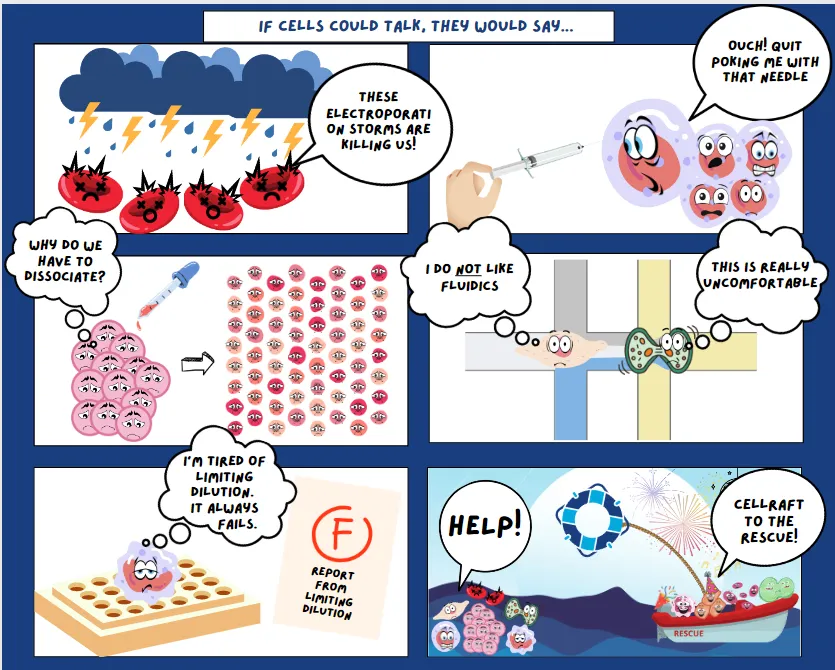
On the first day of orientation, everyone hoping to change careers gathered in this huge room. They started with an overview of procedures and demonstrated fancy equipment that I had never seen before. The first test they gave us involved taking us outside, where there were electroporation storms. Even though we were only outside for a short time, we all managed to get a little sunburned.
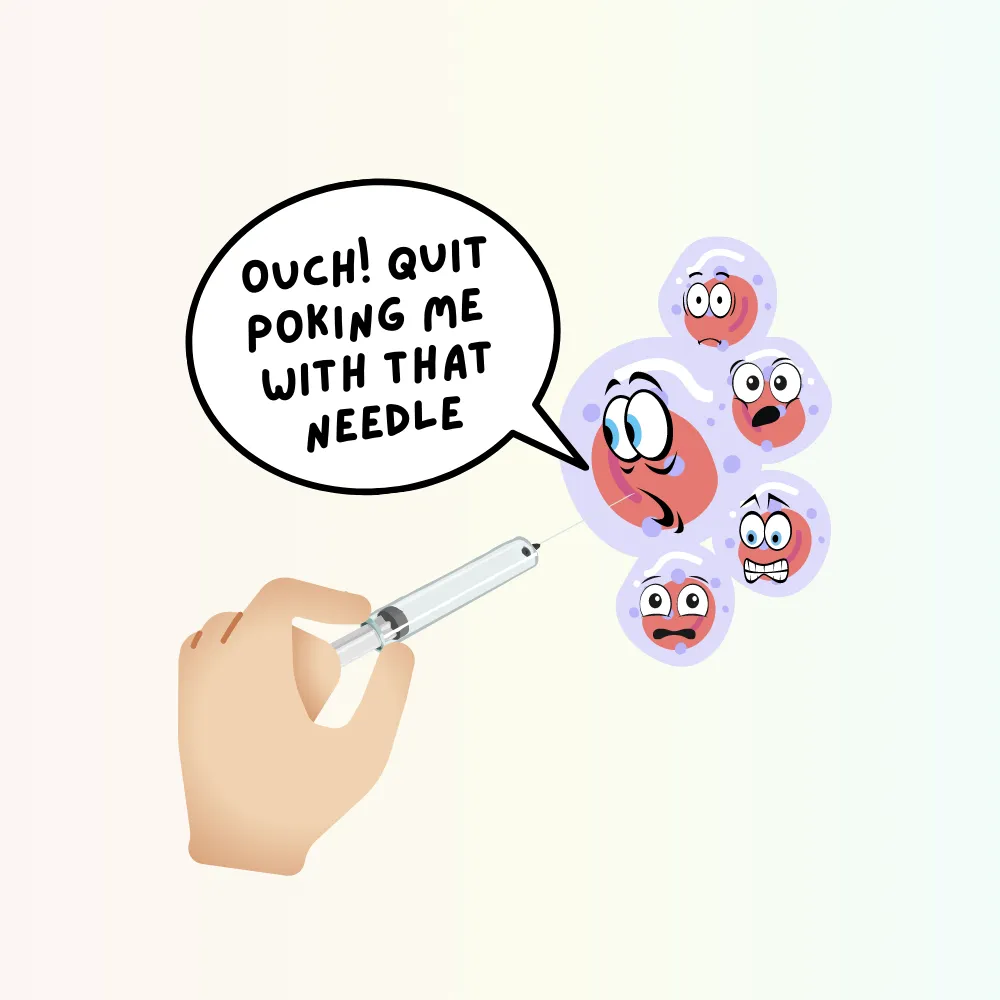
Then, without warning, people wielding sharp objects came at us. They said, “we just need to scrape you off this plate.” I was harshly poked and prodded a million times until they were able to get us where they wanted; most of the other candidates around me gave up and quit.
Some of the friends that I met during orientation remained with me and joined the Cell 101 class. Cell 101 was a really strange class that challenged me. They made us all dissociate from our classmates and get in lines by ourselves. Then, they took us to some weird obstacle courses with narrow tubes that we had to crawl through. A lot of my friends couldn’t fit into the tubes and got stuck. As part of the final examination to become official neurons, they challenged us to find our own homes in wells during the night. Most of my friends failed this examination the first time, including me. None of us had the right map to locate our wells. “How did they expect us to do that without any direction?” This exam was taking forever to pass, and it felt like I was repeatedly facing the same challenges where I knew the answers to the questions but was unable to answer them.
One day, a few of us decided to take a break from studying and go on a vacation to the ocean. There, we saw some neurons partying on a CellRaft, living their best lives. I remember us yelling out to them for “HELP!” and they threw us a CellRaftA microscale polystyrene growth surface within an array used to spatially segregate cells/colonies while maintaining shared media access, enabling imaging over time and targeted isolation. More. I noticed that one of them was a friend in my orientation who gave up because they had been injured when they tried to scrape him around. I asked them, “How in the world did you become a neuron so quickly after all of that ?”
They asked us why we were still taking Cell 101. So, we explained how hard we have been working to pass the final limiting dilutionA statistical cloning approach where cells are diluted to low density to “hopefully” seed one cell per well; commonly used but can be low-efficiency for difficult-to-clone lines. More examination but continued to fail and remain in Cell 101. Most of us were at the point where if we tried the examination one more time and failed, we would to give up. Everyone on the CellRaftA microscale polystyrene growth surface within an array used to spatially segregate cells/colonies while maintaining shared media access, enabling imaging over time and targeted isolation. More was so nice and welcoming to us as we told them about our struggles. Those cells embraced us once we spoke those terrifying words “limiting dilutionA statistical cloning approach where cells are diluted to low density to “hopefully” seed one cell per well; commonly used but can be low-efficiency for difficult-to-clone lines. More,” and reassured us that we would never have to take that examination again.
They told us there was a new course voted ‘Best Cell Class of the Year’ in the Reader’s Digest™, called ‘CellRaftA microscale polystyrene growth surface within an array used to spatially segregate cells/colonies while maintaining shared media access, enabling imaging over time and targeted isolation. More Revolution.’ None of us had ever heard about this alternative course, but when we checked it out online, it was filling up quickly as cells began hearing the news. The ratings were off the charts, with cells of all types expressing their love for this course. One cell wrote, “Easiest A, professor really supported me and gave me all the necessities to become a liver cell.” After reading the user reviews, I raced to sign up for the course because I was afraid it would fill up, and I would be stuck in Cell 101 forever! I was relieved to see they had several options to fit our schedules, and I could begin immediately.
All of us who took a chance with the CellRaftA microscale polystyrene growth surface within an array used to spatially segregate cells/colonies while maintaining shared media access, enabling imaging over time and targeted isolation. More class graduated in no time at all, and realized the future of the cells we had envisioned. There was no poking and prodding, no tube squeezing, no dissociating, and I never had to live alone again. So, I would like to offer some advice to my fellow cells who want to change their careers, explore other options, and figure themselves out: Be different and dare to try new things to become the cell you truly aspire to be. There are better options out there, where everyone is welcome, and that transformative journey starts in the CellRaftA microscale polystyrene growth surface within an array used to spatially segregate cells/colonies while maintaining shared media access, enabling imaging over time and targeted isolation. More Revolution.
 Stemmie Cellis has a lifetime of experience in reprogramming, differentiation, and longevity of culture maintenance. He began his career in somatic cell function and routinely assisted in growth and maintenance of various cells and tissues in the body. Stemmie has faced hardship, frequent relocation, and separation from family. However, he firmly believes that the CellRaftA microscale polystyrene growth surface within an array used to spatially segregate cells/colonies while maintaining shared media access, enabling imaging over time and targeted isolation. More is the solution to prevent others like him from encountering similar challenges in the future. Over the past several years, Stemmie has been leading research and development projects focused on reprogramming, CRISPR/Cas9 editing, and differentiation into specific diseases.
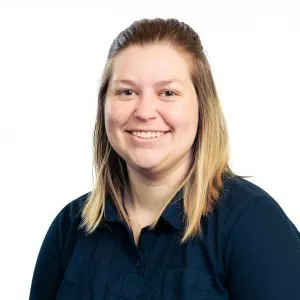
Lexi Land contributes to developing scientific workflows that are compatible with the CellRaft® AIR System. Her focus at Cell Microsystems involves stem cell research, 3D organoid work, as well as adherent and suspension cell culture. Lexi received a Bachelor of Science in Biological Sciences from North Carolina State University with a focus in molecular, cellular, and developmental biology.